
Modular Exhibition Stands: ROI for ATM 2026
Why modular exhibition stands Dubai are the smartest capital decision for ATM exhibitors
Modular exhibition stands Dubai deliver measurable ROI for exhibitors at Arabian Travel Market (ATM 2026). With c.2,800 exhibitors and around 55,000 trade visitors, ATM prioritises speed, repeatability and minimal on-site rework. That makes an investment in reusable, precision-fabricated modular systems not a cost but a capital strategy: you pay more up-front but reduce cumulative build, drayage and MEP surcharges across a multi-show season.
ATM scale, timing and venue constraints that shape ROI
Event facts that matter
- Event: Arabian Travel Market (ATM) — 4–7 May 2026 at Dubai World Trade Centre (DWTC).
- Typical attendance: c.2,800+ exhibitors from 160+ countries and ~55,000 trade visitors.
- Organiser and exhibitor emphasis: compact, modular pavilions that can be reconfigured quickly between halls.
Critical DWTC operational rules
- Standard build height: 4.0m. Anything above requires stamped structural calculations.
- Approvals & RAMS: Stand designs and RAMS must be approved ~30 days before build-up.
- Loading & drayage: Strict booked loading‑bay time‑slots and use of official handlers for drayage.
- Power: Separate 24‑hour power orders are mandatory for fridges, servers and similar equipment.
- F&B limits: Dubai Municipality enforces strict sampling controls — small portions only; no live cooking.
- Surcharges: Venue penalties for late MEP/electrical orders or missed loading slots commonly trigger 20–50% surcharges.
Why per-show math favours modular reuse
Costs that go into your ATM participation include: space hire + build (fabrication & install) + drayage + MEP surcharges. For single‑use, custom builds, the build cost and drayage are repeated each show; for modular systems, the main build cost is capitalised and subsequent shows carry only transport, reconfiguration and routine maintenance. When you add DWTC surcharge risk and the operational benefits of pre‑assembly, modular stands usually win by show two or three.
Operational pain points that inflate multi-show budgets
- Builders skipping warehouse pre‑assembly leading to on-site rework, delays and ad‑hoc costs.
- Missed loading slots triggering official handler surcharge (20–50%).
- Late MEP/electrical orders incurring premium fees.
- High cumulative drayage when crates are heavy or inefficiently packed for each show.
How Burdak mitigates these costs
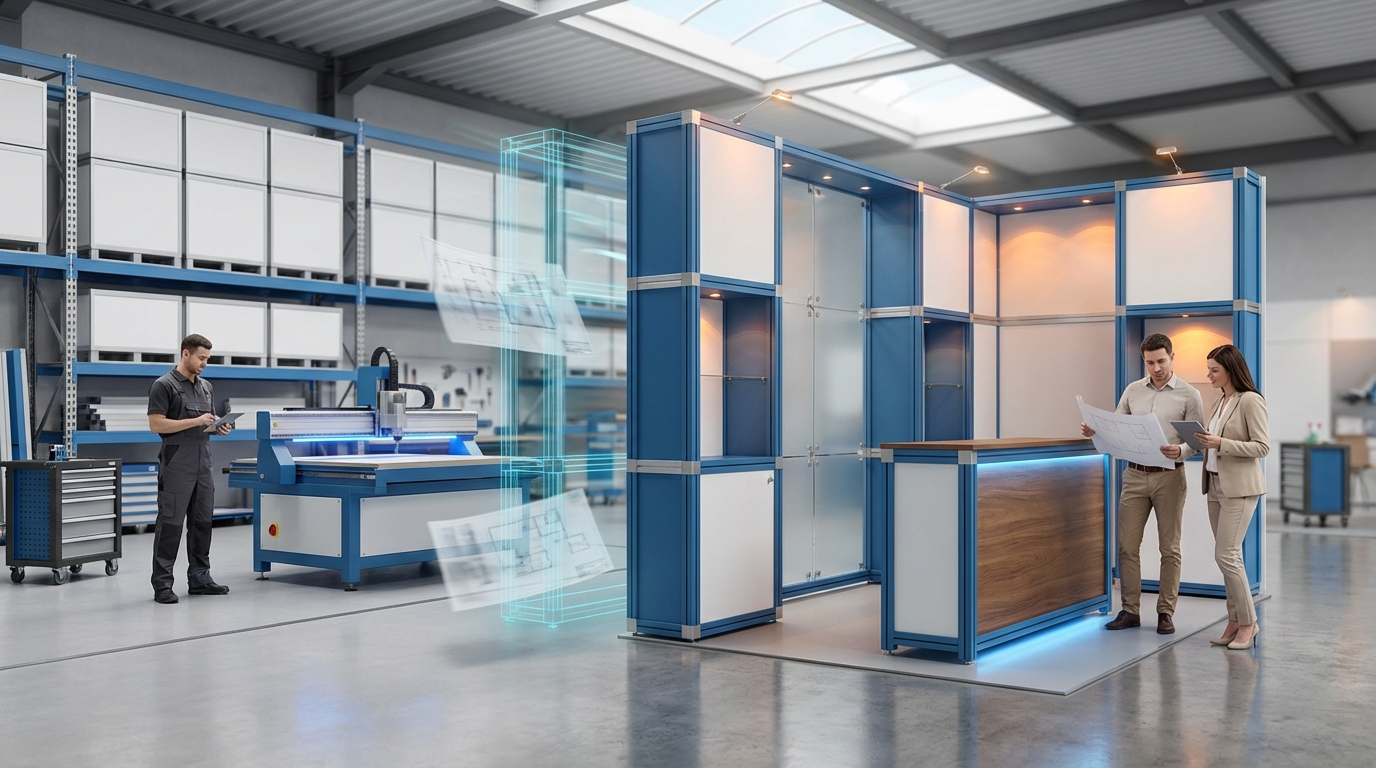
- In‑house fabrication with CNC precision reduces on-site surprises.
- Full‑scale warehouse 3D mockups and pre‑assembly for client sign‑off — guarantees fit and cuts rework.
- Rapid 24–48h quoting and an assigned project manager to manage approvals, RAMS and loading‑bay slots.
- Modular systems designed for rapid reconfiguration and lighter crates — lower official handler drayage and fewer penalties.
Quick amortisation example: modular exhibition stands Dubai (6x6 & 9x9)
The figures below are illustrative examples using Burdak price bands and typical DWTC fee assumptions. Actual costs vary by specification, finishes and services.
Assumptions used (illustrative)
- Space hire (example rate): AED 1,100/sqm.
- Medium stand = 6x6m (36 sqm). Large stand = 9x9m (81 sqm).
- Custom single‑use build vs modular system purchase (Burdak price band example).
- Official handler drayage, MEP and routine reconfiguration fees estimated from market norms.
Medium 6x6 example (36 sqm)
- Space hire: AED 39,600.
- Custom build (per show): AED 75,000.
- Modular system (one‑off purchase): AED 120,000.
- Drayage (custom): AED 12,000. Drayage (modular, optimised): AED 6,000.
- MEP & common surcharges (per show average): custom AED 15,000; modular AED 8,000.
Per‑show totals (illustrative):
- Custom per show: AED 39,600 + 75,000 + 12,000 + 15,000 = AED 141,600.
- Modular first show: AED 39,600 + 120,000 + 6,000 + 8,000 = AED 173,600.
- Modular subsequent shows: AED 39,600 + 6,000 + 20,000 (reconfig) + 8,000 = AED 73,600.
Savings example: Over 3 shows custom = AED 424,800 vs modular = AED 320,800 (save AED 104,000). Over 5 shows custom = AED 708,000 vs modular = AED 468,000 (save AED 240,000).
Large 9x9 example (81 sqm)
- Space hire: AED 89,100.
- Custom build (per show): AED 160,000.
- Modular system (one‑off purchase): AED 260,000.
- Drayage (custom): AED 22,000. Drayage (modular): AED 11,000.
- MEP & common surcharges (per show average): custom AED 25,000; modular AED 12,000.
Per‑show totals (illustrative):
- Custom per show: AED 89,100 + 160,000 + 22,000 + 25,000 = AED 296,100.
- Modular first show: AED 89,100 + 260,000 + 11,000 + 12,000 = AED 372,100.
- Modular subsequent shows: AED 89,100 + 11,000 + 40,000 (reconfig) + 12,000 = AED 152,100.
Savings example: Over 3 shows custom = AED 888,300 vs modular = AED 676,300 (save AED 212,000). Over 5 shows custom = AED 1,480,500 vs modular = AED 980,500 (save AED 500,000).
Practical recommendations for ATM 2026 exhibitors
- Plan for reuse when budgeting — treat the stand as a capital asset, not a consumable.
- Lock design approvals and RAMS at least 30 days out; use a PM to manage submission windows.
- Use pre‑assembly and full‑scale 3D mockups to eliminate on‑site fixes; this cuts both time and surcharge risk.
- Order MEP and any 24‑hour power items early to avoid 20–50% venue penalties.
- Choose builders with in‑house fabrication and CNC capability to guarantee repeatability and lighter packing for lower drayage.
FAQ
What is the DWTC standard build height?
The DWTC enforces a 4.0m standard build height. Structures above this require stamped structural calculations.
When must stand designs and RAMS be approved?
Design approvals and RAMS are typically required about 30 days before build‑up. Late submissions risk rejection or surcharge.
Are there penalties for missed loading slots or late MEP orders?
Yes. Venue penalties and official handler surcharges for missed slots or late MEP/electrical orders commonly range from 20–50% of the relevant service cost.
How does Burdak reduce risk and overall cost?
We provide in‑house fabrication, CNC precision, and full‑scale warehouse 3D mockups and pre‑assembly for client sign‑off. We offer 24–48h quotes and assign a project manager to control timeline, approvals and loading‑bay bookings — reducing rework, surcharges and cumulative drayage.
Is modular always cheaper?
Modular systems carry a higher up‑front cost but typically show payback by show two to three for medium stands and by show three to four for larger footprints. The break‑even depends on finish level, show frequency and the risk of DWTC surcharges; our examples demonstrate typical outcomes.