
Prevent Demo Blackouts at Seamless 2026 — Exhibition Power Backup Dubai
Seamless Middle East 2026 (12–14 May 2026) is a high‑stakes environment where reliable exhibition power backup Dubai is non‑negotiable. With an expected 700–900 exhibitors and 25,000+ trade visitors at DWTC, a single demo blackout can mean lost leads, exhibitor surcharges and reputation damage. We outline exactly how these failures occur, DWTC rules and costs, and Burdak’s factory‑tested solution to keep your demo running.
Why Seamless 2026 makes power resilience mission‑critical (exhibition power backup Dubai)
Seamless 2026 runs 12–14 May at Dubai World Trade Centre. The event’s scale and density of AV rigs, LED walls and live demos increases the probability of electrical disturbances. Key risks:
- High simultaneous demand: hundreds of exhibits drawing inrush currents from LED walls, motors and live cooking demos.
- Strict venue enforcement: late technical orders and incorrect specifications can lead to service denial or surcharges.
- Commercial exposure: a 30‑minute outage can cost dozens of warm leads; some exhibitors report conversion hit rates of 10–20% per hour offline.
DWTC power rules, costs and common failure modes
EventPlus ordering and surcharges
DWTC uses tiered EventPlus ordering: Early, Standard and Late. Late orders are charged a 20–50% surcharge and may be subject to availability. That applies across power, civils and LAN services.
24‑hour and three‑phase power
Three‑phase and 24‑hour circuits must be ordered separately and are delivered via standard IEC/CEE connectors. If you need constant power (for refrigerated display, demo rigs, or live streaming) order “24‑hour power” explicitly — DWTC will not assume continuous supply.
Common failure modes on site
- Under‑specified three‑phase feeds or incorrect phase balancing, causing voltage dips.
- High inrush currents from LED walls and power amplifiers tripping upstream breakers.
- Late orders forcing temporary single‑phase solutions or hire gear with insufficient capacity.
Typical early‑order LAN hardlines are US$500–$800; assume 10–30% premium if you rely on guaranteed vendor support at the show.
Technical anatomy of a demo blackout
Inrush currents and breaker curves
Most blackouts start with an unchecked inrush current when capacitive or motor loads energise. Circuit breakers have time‑current curves: a surge that is short but high may be tolerated by a slow curve but will trip a fast or incorrectly sized breaker. Knowing the breaker characteristic (B, C, D curve) is essential.
Sequencing, soft‑start vs UPS strategies
Sequential energising, soft‑start (ramped drive) and appropriately rated UPS systems prevent simultaneous inrush. UPS units with high peak current capacity and built‑in sequencing or external soft‑start modules are preferred for exhibition environments. A UPS alone without inrush management can still lead to nuisance trips if not tested to the exact load profile.
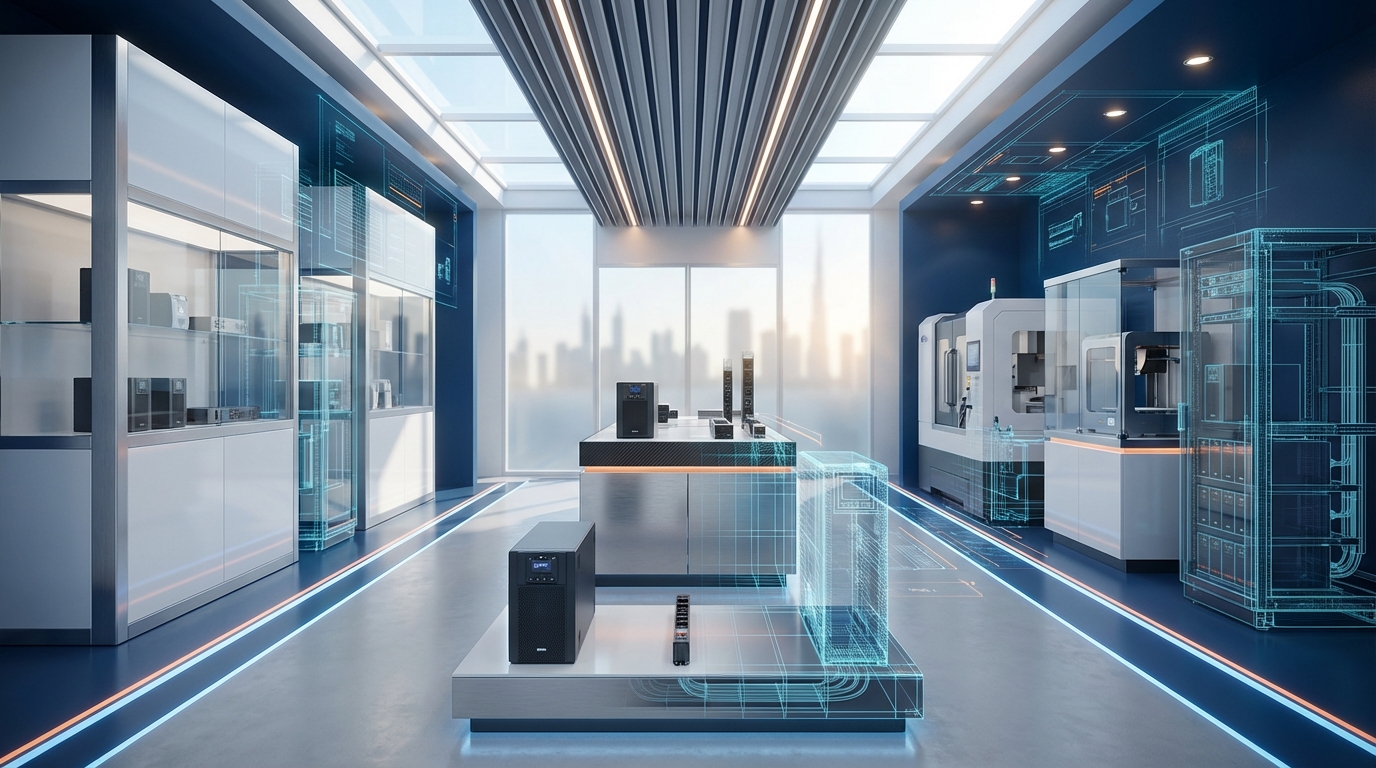
Burdak’s factory solution — design, CNC‑built UPS enclosures & micro‑PDU pre‑assembly
We design, fabricate and test in‑house to remove the uncertainty of on‑site fixes. Key elements:
- In‑house fabrication: CNC‑built UPS enclosures sized to DWTC booth dimensions and ventilation rules.
- Micro‑PDU pre‑assembly: pre‑wired PDUs and distribution looms fitted and labelled in our shop—reduces on‑site wiring errors and inspection time.
- 3D mockups and shop drawings: full‑scale 3D mockups for mechanical, HVAC and electrical fit checks; shop drawings submitted for DWTC sign‑off.
- Inrush testing & RAMS: full electrical test lab runs including inrush profiling, breaker curve validation and a complete RAMS package for venue inspection.
Because we conduct full‑scale testing in our factory, we cut on‑site build time by 40–60% and reduce late order exposure. Unlike many competitors who subcontract testing, our integrated lab avoids extra markups and failure points.
Implementation timeline & exhibitor checklist
Recommended timeline for Seamless 2026:
- 6–8 weeks out: approve booth electrical layout, RAMS, and 3D mockup sign‑off. Confirm HVAC and structural sign‑off for LED walls over 2.5m.
- 4–6 weeks out: place EventPlus orders (Early/Standard) for three‑phase and 24‑hour power; order hardline LAN if required.
- 2–4 weeks out: finalise micro‑PDU configuration and UPS sizing; schedule factory acceptance test (FAT).
- On‑site (build week): deliver CNC‑built enclosures and pre‑assembled PDUs; rapid install and DWTC electrical inspection prior to energising.
Exhibitor checklist:
- Approve shop drawings and 3D mockup (6–8 weeks)
- Order 24‑hour power and three‑phase via EventPlus (4–6 weeks)
- Confirm UPS and inrush specs with Burdak (4 weeks)
- Sign off FAT and RAMS (2–3 weeks)
- Book DWTC inspection window and delivery slots
Cost/ROI comparison and a sample case study
Typical costs avoided with Burdak’s factory solution:
- Late order surcharge: Avoid 20–50% on power/hardline fees by ordering early and using pre‑tested gear.
- Reduced on‑site hours: Factory pre‑assembly reduces labour by 40–60% — savings on rigging and electricians.
- Avoided lost leads: A 1‑hour demo outage at a busy show can cost an exhibitor an estimated US$2,000–5,000 in lost sales opportunity (variable by sector).
Sample case study
Client: FinTech exhibitor with LED wall and demo kiosks. Situation: high inrush profiles tripping venue breakers. Intervention: Burdak delivered CNC UPS enclosure with micro‑PDU pre‑wiring, sequencing and FAT. Numbers:
- On‑site labour reduced from 25 to 10 hours (60% reduction).
- Late order surcharges avoided: US$1,200.
- Estimated avoided lost leads/sales opportunity: US$3,500 for full show uptime.
- Total project premium over basic hire: US$1,800, net ROI positive when accounting for avoided loss and reduced on‑site hourly charges.
Technical spec appendices and downloadable templates
We provide downloadable templates and appendices tailored for Seamless 2026:
- Sample RAMS (Risk Assessment and Method Statements)
- Electrical grid plan template for DWTC submission
- UPS selection guide and inrush profiling worksheet
- Shop drawing checklist and 3D mockup sign‑off form
Contact us to receive these templates and have your drawings reviewed by our engineering team before you submit EventPlus orders.
FAQ
Do I need to order 24‑hour power separately from three‑phase?
Yes. DWTC requires a separate request for 24‑hour power. Three‑phase feeds are not automatically 24‑hour.
How late can I place EventPlus orders without risking availability?
Late orders are charged a 20–50% surcharge and are often subject to availability. Order during the Early/Standard windows (4–6 weeks out) where possible.
Why do LED walls trip breakers at shows?
LED walls and large amplifiers have high capacitive inrush. If multiple devices energise simultaneously, the cumulative inrush exceeds breaker tolerance or UPS bypass thresholds. Sequencing and inrush testing are required to prevent trips.
What makes Burdak different from other suppliers?
We provide in‑house fabrication, a test lab for inrush profiling, CNC‑built UPS enclosures, micro‑PDU pre‑assembly and 3D mockups. Many competitors subcontract these functions, increasing cost and risk.
How do I start with Burdak for Seamless 2026?
Contact us with your booth number, load list and LED/AV specifications. We will produce shop drawings, schedule a FAT and prepare a RAMS package aligned with DWTC requirements.